
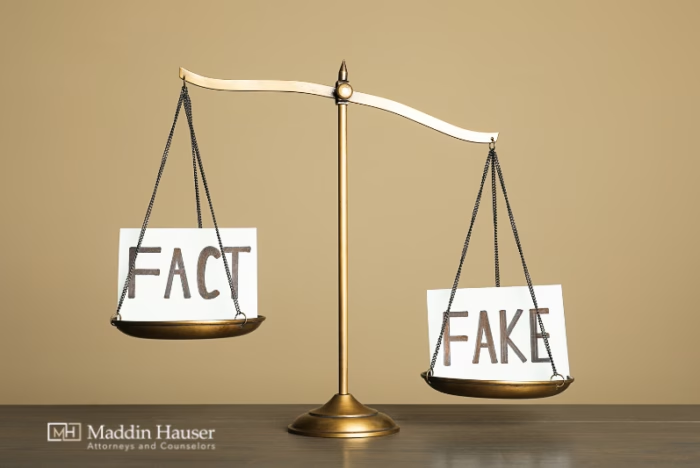
Unreality Bites: The Dangers of “Deepfakes” and Other AI-Generated Evidence in Divorce Litigation
If recent headlines are to be believed, artificial intelligence (AI) may soon kill us all. Even before the Terminators arrive, however, AI can still cause havoc in other respects. This includes creating content, pictures, video, audio recordings, and other content so sophisticated that they are indistinguishable from reality, even though they are completely manufactured.
It can be entertaining, albeit slightly unsettling, when you see an AI-fabricated video clip of George Washington playing pickleball against Alfred Einstein or something akin to that. But if you are in the middle of a contentious divorce and custody battle, a “deepfake” video that shows you passed out drunk on a bench at a playground while your small child plays unsupervised nearby is not amusing.
Underhanded tricks and dubious conduct have been part of the divorce process since the practice of divorce has been around, but AI’s ability to create false or manipulated evidence can take such malfeasance to profoundly new and destructive heights. If not ultimately proven to be fake, such AI creations can influence decisions concerning child custody, parenting time, domestic violence allegations, marital misconduct, dissipation of assets, and a variety of other issues. Conversely, the mere existence of such plausible facsimiles of reality can support claims that falsely characterize authentic evidence as AI-generated.
This presents courts, litigants, and lawyers with evidentiary challenges that go beyond authenticating or debunking documents or signatures. Deepfakes and other AI-generated content will require greater vigilance, vetting, and preparation to avoid false claims and denials. If you are anticipating or are in the middle of a divorce or custody fight, here is what you need to know about the new and frightening evidentiary frontier.
What Are Deepfakes?
Let’s start by understanding what a deepfake is. A deepfake is digitally manipulated or AI-generated content designed to make it appear that a person said or did something that never actually occurred. AI tools can generate realistic photographs and videos, clone voices, alter facial expressions, and create convincing conversations or other forms of digital content. If you are online at all, you have likely seen a deepfake cross your transom more than once.
In the context of divorce, deepfake technology can allow even a technically challenged spouse to create an apparently authentic video purporting to show the other spouse engaging in inappropriate conduct, such as the aforementioned drunk at a playground. Similarly, an audio recording could be manipulated to make it appear that a parent made threatening or disparaging statements. AI could also be used to fabricate text messages, social media posts, emails, photographs, or other communications that imply infidelity, financial misconduct, or other damaging actions or statements.
While AI is more than capable of manufacturing realistic content out of thin air, it can also take genuine videos, photos, or recordings and alter them in ways that change their meaning while retaining enough of the original content to appear credible.
Why Deepfakes Are Particularly Dangerous in Divorce Cases
What makes deepfake technology particularly insidious in divorce matters is that anyone can easily create fabricated evidence, especially someone who is angry, impulsive, vengeful, or out to gain an advantage in a deeply personal fight over assets or children. Even if ultimately proven false, allegations based on deepfake evidence concerning substance abuse, domestic violence, infidelity, parental fitness, or inappropriate conduct can poison a parent’s relationship with their children or harm reputations with friends, colleagues, and the community. The mere presentation of a deepfake can affect negotiations, temporary custody decisions, or the court’s perception of a parent before its authenticity is established.
Deepfakes can therefore cause harm even if they are ultimately exposed as fraudulent. Litigation is expensive, and fabricated evidence may force the opposing party to spend substantial time and money investigating, authenticating, and rebutting it.
Casting Doubt on Authentic Evidence
The danger of AI and deepfakes runs in both directions. Claiming that a piece of damaging evidence is fabricated is far easier to do now that impeccable fabrications are everywhere. A spouse who actually sent an incriminating text message could claim that the message was AI-generated. A genuine photograph could be dismissed as manipulated. An authentic recording could be characterized as an artificial voice clone.
This creates an evidentiary environment in which simply possessing a digital file may not be enough. Parties increasingly may need to establish where the evidence came from, how it was preserved, whether it has been altered, and whether other evidence independently corroborates its contents.
New Frontiers in Authentication
When disputes arise regarding digital evidence, authentication can become a central issue in a divorce proceeding. The precise requirements will depend on the jurisdiction, the type of evidence, and the circumstances under which it was obtained and preserved. Generally, however, counsel should consider the source of the evidence and its chain of custody, and whether metadata, original files, device records, cloud records, or other information can help establish authenticity.
For example, an original photograph stored on a phone may provide substantially more information for authentication than a screenshot circulated through multiple devices. Similarly, producing an entire conversation, rather than a selectively cropped screenshot, may provide important context.
Independent corroboration may also be valuable. Telephone records, contemporaneous communications, witnesses, financial records, location information, or other evidence may help establish whether an allegedly fabricated communication or recording is consistent with events that actually occurred.
Anyone involved in, or expecting, a contentious divorce should therefore be careful to preserve potentially relevant electronic evidence. Parties should avoid editing, cropping, filtering, re-saving, or otherwise altering original files unnecessarily.
Counsel should also consider preserving relevant devices, original communications, photographs, recordings, and associated metadata when appropriate. In some cases, forensic examination by a qualified digital-evidence professional may be warranted.
Importantly, parties should not attempt to “prove” authenticity by creating additional versions of evidence or using AI tools to analyze or enhance the original without first preserving the original file. Doing so may create additional authentication questions.
Regardless of what tomorrow holds for AI and humanity, today provides plenty of challenges for divorcing spouses and others engaged in hard-fought, emotionally charged litigation. Reining in or countering the potentially dangerous and damaging aspects of AI in this context may ultimately prove to be just as difficult as stopping Skynet, but it is certainly a necessary battle.
If you have questions or concerns about how AI or deepfakes may impact your divorce or custody matter, please contact Stewart Weiner at Maddin Hauser.