
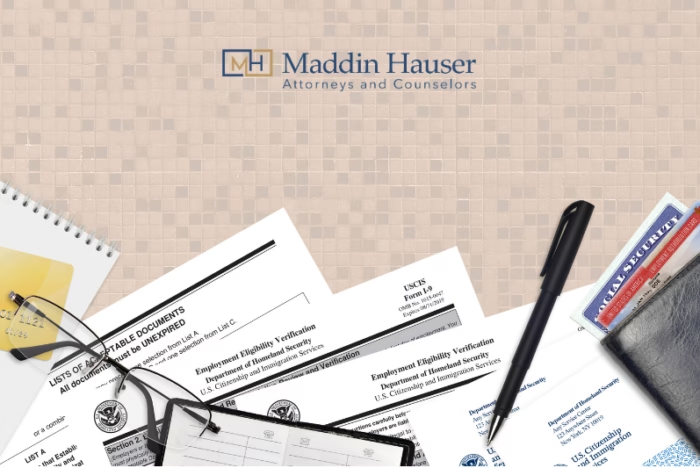
Recently Updated I-9 Guidance From ICE Turns Up the Heat on Employers, Changing Formerly “Technical” Errors Into Substantive, Costly Transgressions
Immigration and Customs Enforcement (ICE) has significantly increased its enforcement activity across all of its functions in the past several years. Consistent with this trend, ICE has also made clear to the nation’s employers that formerly technical, no-harm-no-foul, fix-it-and-forget-it compliance errors with Employment Eligibility Verification Forms (Form I-9) are now being treated as serious, substantive, immediately fineable violations.
While workplace investigations and I-9 audits by ICE were never welcome events, recent ICE guidance has transformed an unwelcome disruption into a serious, costly concern that requires increased attention and vigilance, as well as an approach that treats I-9 compliance as a business priority rather than a routine administrative function for the human resources department. In a very real sense, there is no longer a margin for error, no do-overs, when it comes to I-9s.
I-9 Background and Historical Treatment of Violations
Federal law requires employers to verify the identity and employment authorization of every individual hired after November 6, 1986, by properly completing and maintaining Form I-9. Employers must also retain these forms for the required retention period and make them available for inspection upon request.
For the past three decades, errors with I-9s have been classified as either “technical” or “substantive.” A technical or procedural violation generally involves an administrative mistake that does not undermine the employer’s verification of an employee’s work authorization. If an inspection found a technical violation, the employer could correct it either during an internal audit or within 10 business days after ICE issued a Notice of Technical or Procedural Errors. A substantive violation, however, involves failures that affect the integrity of the verification process itself. These violations are generally not subject to a cure period and may result in civil penalties regardless of whether the employee was legally authorized to work.
The March 2026 guidance significantly narrows the types of errors that fall within that relatively innocuous and easily fixable classification, reducing employers’ opportunities to cure mistakes after receiving a Notice of Inspection (NOI) and exposing them to immediate civil penalties.
In its March 16, 2026, guidance, ICE identifies a lengthy list of formerly technical deficiencies that they will now treat as substantive. For example, a missing employee name or date of birth in I-9 Section 1 was, until recently, a technical violation that could be resolved by simply adding the missing information and signing and dating the correction. Now, it may result in a substantial penalty without any opportunity to cure the violation. Other examples include certain omissions involving required employee attestations, employer certifications, verification documentation, and other information necessary to establish that the employer properly completed the verification process.
The shift is substantial: the guidance now treats roughly 30 categories of errors as substantive, leaving only eight that remain technical.
Increased Financial Exposure for Violations
Civil penalties for I-9 violations have steadily increased over the years through inflation adjustments, and substantive violations can become expensive quickly.
ICE generally assesses penalties on a per-form basis. Consequently, what appears to be a small recurring error in an employer’s onboarding process can multiply into significant liability if dozens or hundreds of I-9 forms contain the same defect.
ICE also evaluates several factors when determining penalty amounts, including:
- The size of the employer’s business.
- The employer’s good faith.
- The seriousness of the violations.
- Whether unauthorized workers were employed.
- The employer’s history of previous violations.
Even employers that hire only authorized workers may face substantial fines if their documentation practices fail to satisfy federal requirements.
In addition to monetary penalties, I-9 violations may trigger additional government scrutiny, follow-up inspections, reputational harm, and increased legal costs associated with responding to investigations.
Proactive Steps Employers Should Take Now
Although the new guidance is guidance, not a statute or regulation, it signals ICE’s current enforcement position. The best way to prepare for an ICE audit is to conduct an internal one and take other proactive and corrective steps before agents come knocking. Employers should consider conducting a comprehensive internal review of their I-9 compliance procedures, including the following:
- Review all existing I-9 forms. Identify incomplete forms, inconsistent practices, missing signatures, improper dates, or other deficiencies before they become the subject of a government inspection.
- Standardize onboarding procedures. Ensure that everyone responsible for hiring follows the same written procedures for completing Form I-9.
- Train HR personnel and managers. Employees responsible for completing I-9s should receive regular training on current requirements and common compliance mistakes.
- Monitor documentation retention requirements. Employers should retain I-9 forms for the required period and promptly destroy those that have exceeded their retention requirements to reduce unnecessary audit exposure.
- Perform periodic internal audits. Regular self-audits can identify recurring errors, improve consistency, and demonstrate good-faith compliance efforts.
- Maintain organized records. Whether forms are maintained electronically or on paper, employers should be able to quickly locate and produce them if ICE initiates an inspection.
- Document corrections properly. When errors are discovered, corrections should be made using accepted procedures rather than attempting to conceal or recreate documents.
Work With Counsel To Develop an Audit Response Plan and Comprehensive Compliance Program
In addition to the foregoing steps, employers should establish an internal protocol for responding to an ICE inspection so that their human resources team and other employees don’t have to go into fire-drill mode. HR personnel, management, and legal counsel should understand who is responsible for receiving government notices, gathering records, communicating with investigators, and overseeing document production.
Having a response plan in place can reduce confusion during the limited three-business-day response period and help ensure that communications with government investigators are coordinated appropriately.
Because I-9 requirements continue to evolve, and because ICE enforcement activity has increased significantly, employers should not assume that procedures adopted several years ago remain compliant today. Experienced employment counsel can assist employers by conducting privileged internal audits, reviewing onboarding practices, developing written compliance policies, providing management training, and advising employers regarding corrections they can make before an inspection occurs.
If you have questions about these recent changes to Form I-9 enforcement or would like assistance developing a comprehensive I-9 audit and compliance program, please contact Mariel Newhouse at Maddin Hauser.